
Practical AI for Real-World Network Operations
In recent years, the networking industry has been hearing that AI will fix all our operational problems. And most of what followed was either vague dashboards, brittle anomaly detection, or black-box promises that didn’t really work with production networks.
What’s changing now isn’t just the maturity of AI models or the latest bolt-on clever chatbots - it’s how those models are being applied in real-world network operations. Aviz Network Copilot represents a shift away from generic AI tooling and toward operator-centric, context-aware network intelligence, designed to fit the way real networks are built and operated.
This is not AI for AI’s sake. It’s AI embedded directly into the workflows network engineers already live in.
The Problem Network Copilot Is Actually Solving
Network operations are often correlation problems. When a remote site can’t reach an application, the root cause could lie in routing, security policy enforcement, transport, software versions, configuration drift, or even a change made minutes earlier by a different team. Today, most engineers still solve this by manually hopping between devices, management systems, dashboards, and ticketing tools.
That process doesn’t scale.
Aviz Network Copilot is designed to collapse that manual investigation loop by ingesting operational data from across the network, correlating it, and presenting actionable answers through a conversational interface, rather than forcing engineers to reverse-engineer the truth themselves.
Instead of asking,
Which device is the source of the problem?
Which logs should I be looking at?
Which dashboards do I need, and how do I interpret them?
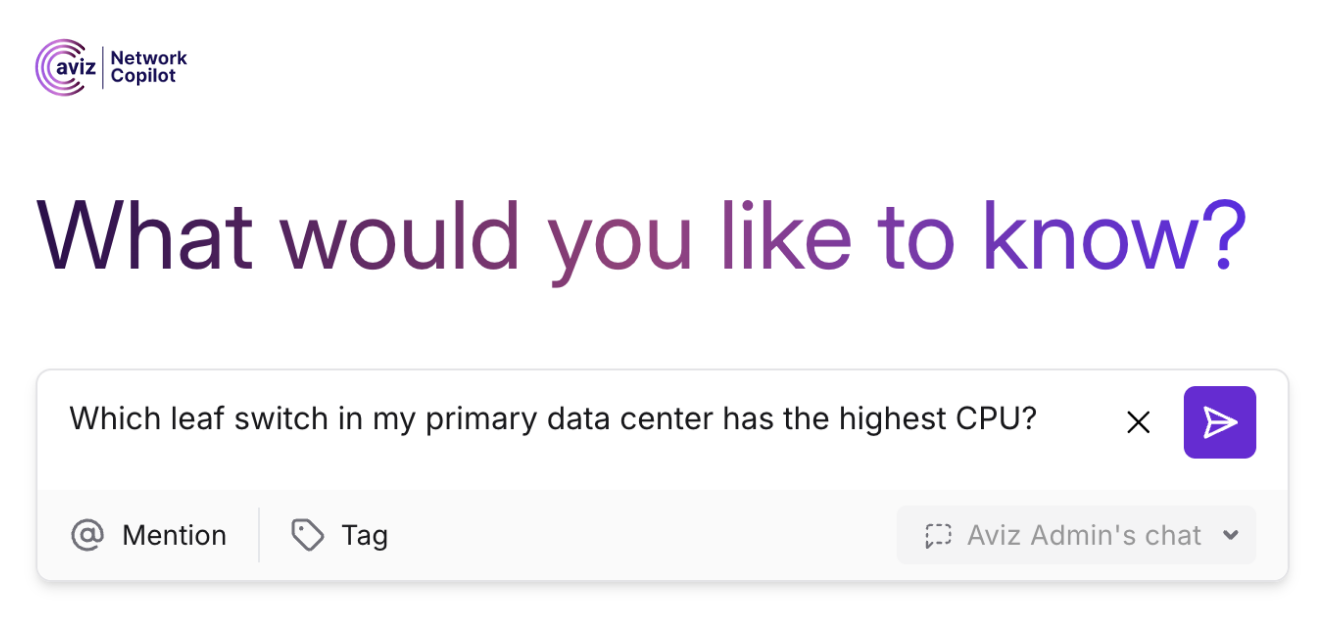
Engineers can ask, “Why can’t users at Site A reach this application?”, and get a structured, explainable response grounded in live network data.
Notice in the image below that engineers can interface with their networks using a familiar chat interface.
An Architecture Built for NetOps Reality
One of the most important design decisions in Network Copilot is where it runs. Aviz deliberately designed Network Copilot as an on-premises, private GenAI solution, running on customer-owned infrastructure with optional GPU acceleration. Network data does not leave the environment and is not used to train public models.
From an architectural standpoint, Network Copilot consists of several key layers:
First, we have the data ingestion and normalization layer.
Network Copilot connects to a broad set of operational data sources which you can see in the basic data pipeline from left to right, including:
SNMP, gNMI, APIs
Syslog and files
Firewall logs
Flow data (NetFlow, sFlow)
Centralized controllers like Nexus Dashboard
External platforms such as Splunk, Influx, NetBox, cloud object storage, and more
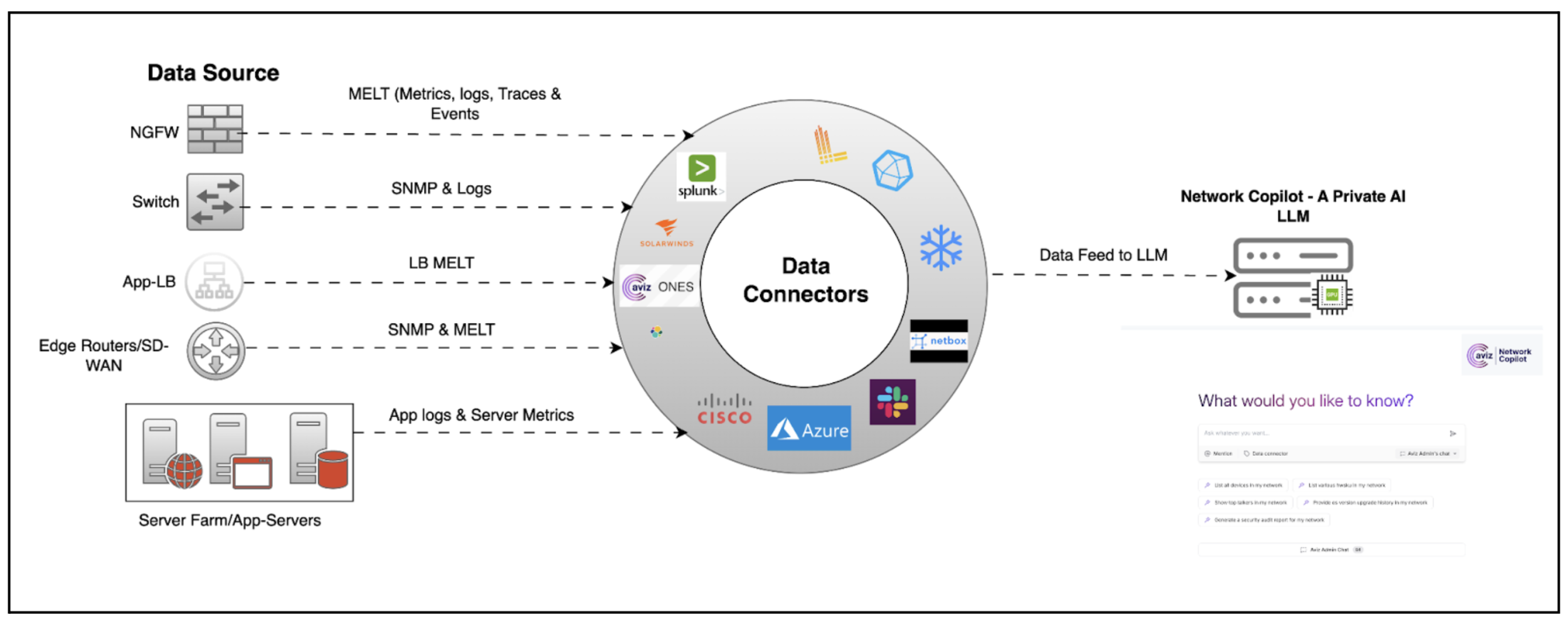
Figure 1: Data Source Ingestion via Data Connectors to Network Copilot
Rather than treating this as raw telemetry, the platform performs calculations, normalization, and time-series storage, creating a usable operational data layer. This matters because AI systems are only as good as the structure and formatting of the data they reason over.
Second, Network Copilot utilizes a hybrid RAG system.
Network Copilot combines live telemetry with a knowledge base that includes hardware and software lifecycle data, CVEs, known bugs, and customer-provided documents and internal references.
In the image below, under Knowledge Base, notice that the Network Copilot system adds this additional information to provide richer context. Then, this information is indexed using a hybrid RAG approach, allowing the AI to ground its answers in both real-time network state and authoritative reference material.
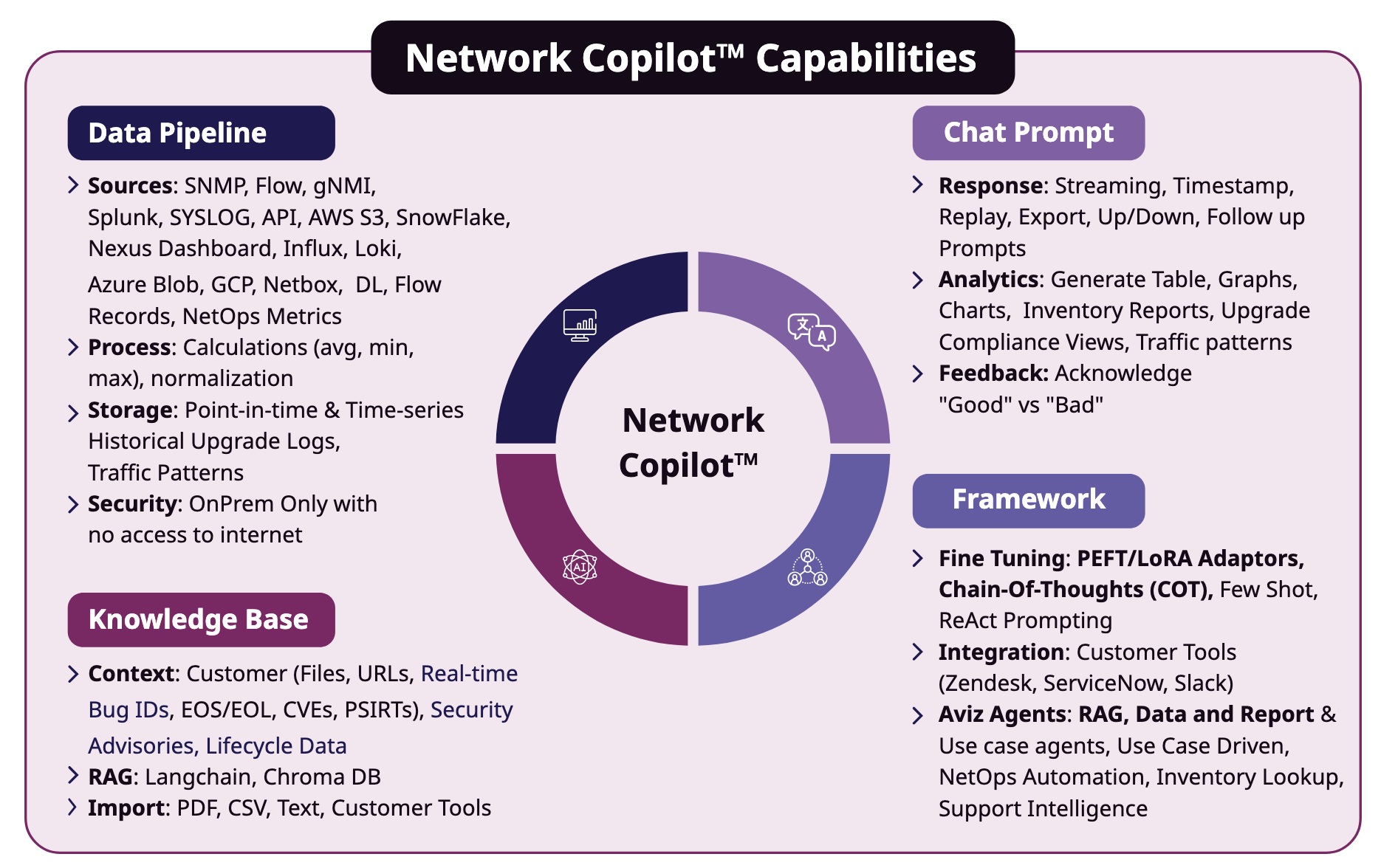
RAG, or retrieval augmented generation, limits the LLM to only the external database that engineers care about, which ensures responses are accurate. Importantly, this isn’t just a document search. The RAG system, built on Langchain and Chroma DB, is tightly integrated with operational context, making the responses far more relevant than generic LLM outputs.
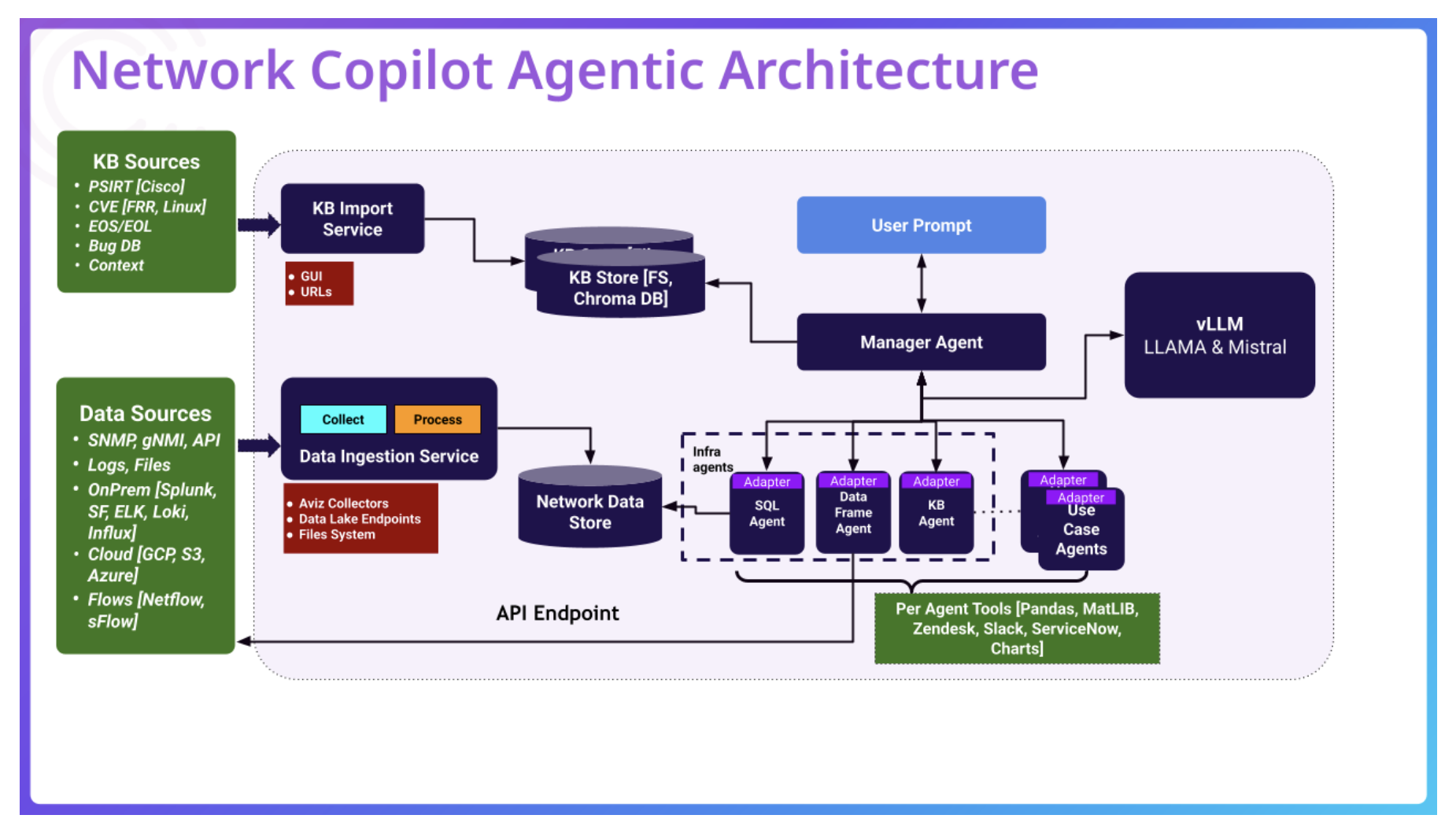
Third, Network Copilot uses AI reasoning and an agentic approach.
On top of the data and knowledge layers sits the AI reasoning engine. Network Copilot supports multiple local or external LLM options, fine-tuning via PEFT/LoRA adaptors (methods to more easily and efficiently fine-tune a model), chain-of-thought reasoning, purpose-built agents focused on inventory, RCA, audits, reporting, and operational insights.
The key idea is that AI agents are use-case driven, not general-purpose chatbots. Each agent focuses on a bounded operational problem, which is exactly how experienced engineers work.
Core Use Cases That Actually Matter
Aviz Network Copilot shines where network teams spend the majority of their time.
Root Cause Analysis
Often, the main focus for most engineers in day-to-day operations is root cause analysis after an incident. Instead of manually checking devices, logs, routing adjacencies, and configuration changes, engineers can ask a single question and receive a well-researched and reasoned explanation.
The system can analyze recent configuration changes, compare running vs historical state, correlate logs, routing events, and flow data, and even identify likely failure domains. This dramatically reduces time-to-understanding, not just time-to-resolution.
Inventory, Compliance, and Lifecycle Management
Another area where engineers spend a significant amount of time is with inventory, compliance, and lifecycle management. Network Copilot can answer questions like:
Which devices are running vulnerable software?
What hardware will be out of support in the next 180 days?
What upgrade paths are recommended?
These are questions engineers ask constantly, but rarely get answered quickly.
Capacity Planning and Network Health
Where Network Copilot shines is with capacity planning and analysis, as well as overall network health insights.
By analyzing utilization, traffic patterns, and historical behavior, the platform can surface insights such as top talkers, bandwidth trends, anomalous utilization changes, and hard-to-detect early warning signs before thresholds are crossed. This moves NetOps away from reactive firefighting and toward proactive operations.
Why Network Copilot Is Different
What distinguishes Aviz Network Copilot is not that it uses AI, but how it uses it.
Most “AI for networking” products either wrap a generic chatbot around limited data or perform narrow analytics without operational context. Network Copilot sits between those extremes and treats AI as a reasoning layer over operational data as well as a force multiplier for existing NetOps workflows. The bottom line is that any AI system must be explainable, secure, and controllable to be truly useful in real-world NetOps applications.
Just as important, Network Copilot recognizes that NetOps maturity varies. Customers can start with read-only insights and root cause analysis, then gradually evolve toward more advanced automation and agent-driven workflows over time.
The Bottom Line
Aviz Network Copilot isn’t a magic button, and that’s exactly why it works. It acknowledges the realities of production networks, including heterogeneity, operational risk, human accountability, and the need for trust. By combining on-prem AI, deep operational data access, hybrid RAG, and use-case-driven agents, it delivers something network teams have been missing: AI that understands networks the way engineers do.
